
Not all parts of a farm contribute equally to nutrient losses. The right mitigation, in the right location, can deliver lasting benefits.
LEI helps farmers turn science into practical, farm-specific solutions. We don’t just apply the same approach across an entire property, we look at how water, nutrients and sediment move through the landscape, identify the areas contributing most to losses, and develop targeted solutions that work with the farm's existing systems and management practices.
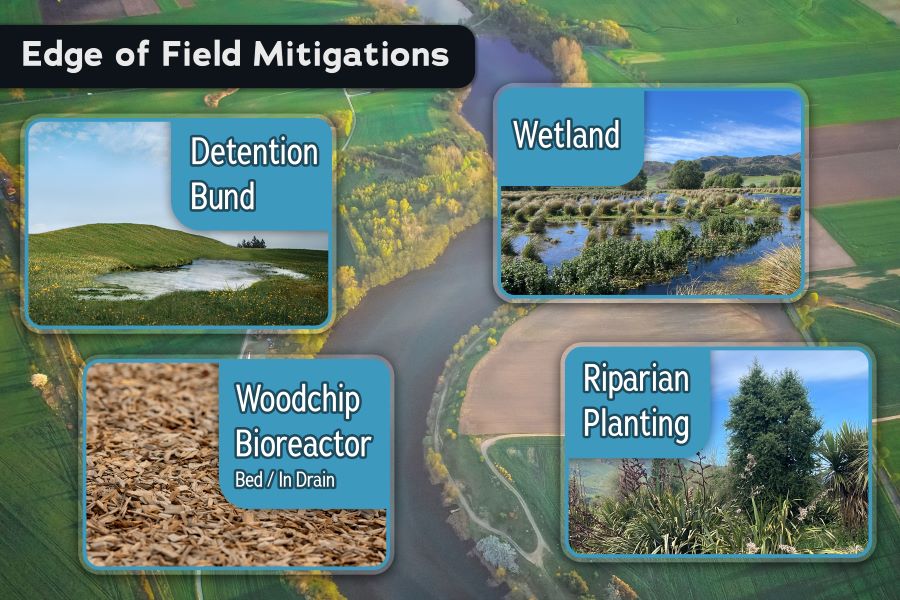
Talk to our team about practical edge of field mitigation options, including wetlands, bioreactors, detention bunds and riparian planting, tailored to your property and farming system.
Get in touchFor most farms, nutrient losses do not occur evenly across the landscape. Water often leaves through specific pathways such as tile drains, swales, culverts, natural depressions and paddock outlets. These critical source areas can become highly effective intervention points, allowing contaminants to be intercepted before they reach waterways. In many cases, relatively small, targeted improvements can deliver meaningful environmental benefits while minimising impacts on farm productivity.
Nutrient management is often discussed as a compliance issue, but successful projects usually start by understanding how a property functions and where the opportunities are.
A Farm Environment Plan or site assessment can identify where nutrients and sediment are most likely to leave the farm and help prioritise practical improvements. Frequently, the best solution is not about changing the entire farming system, but making strategic use of areas that are already challenging to farm. A boggy corner that never performs well, for example, may be better utilised as a treatment wetland that improves water quality while creating biodiversity benefits and reducing ongoing management headaches.
The aim is simple: keep nutrients on the farm where they contribute to production, rather than allowing them to be lost to groundwater, drains, streams and rivers.
There is no single mitigation measure that works everywhere. The most successful projects are those that match the right tool to the specific contaminant, landscape and flow pathway.
Constructed wetlands remain one of the most versatile options. By slowing water movement and creating opportunities for sedimentation, plant uptake and natural biological processes, wetlands can reduce nitrogen, phosphorus and sediment losses while also providing habitat and biodiversity benefits. They are particularly effective where drainage systems can be directed through the wetland before water reaches a receiving environment.
In situations where nitrogen is the primary concern, woodchip bioreactors can offer a highly targeted solution. These systems direct drainage water through a woodchip-filled trench or bed where naturally occurring bacteria convert nitrate into nitrogen gas. Because the process occurs below ground or within existing drainage infrastructure, bioreactors can often be installed with very little loss of productive land. They are passive systems with relatively low maintenance requirements and are proving increasingly valuable in tile-drained and artificially drained catchments.
Where sediment and phosphorus losses are associated with surface runoff, detention bunds and riparian planting can play an important role. Detention bunds temporarily hold back stormwater, allowing sediment and phosphorus to settle before water is released downstream. Riparian planting helps slow overland flow, trap sediment, stabilise stream banks and improve habitat values. In many situations these measures are most effective when integrated with broader farm drainage and water management systems rather than implemented in isolation.
While regulatory requirements often drive interest in nutrient management, the benefits extend well beyond compliance.
Targeted edge-of-field mitigations can help support Farm Environment Plan objectives, contribute to catchment-wide water quality improvements, improve resilience to changing weather patterns and demonstrate environmental stewardship to customers, communities and supply chains. They can also help farmers stay ahead of future regulatory requirements by building long-term resilience into their farming systems today.
At LEI, we combine practical farm experience with the latest scientific research to help clients make informed decisions about nutrient management and water quality improvement.
Our team actively contributes to the development of new knowledge in this field. Environmental Scientist Dr Stefanía Romero recently published research on the use of woodchip bioreactors to reduce nitrate losses from agricultural drainage systems. Her work strengthens our understanding of where these systems are most effective and supports our ability to design practical, evidence-based solutions for New Zealand farming systems.
While every site is different, research like this helps ensure the advice we provide is not only practical and achievable, but grounded firmly in current science.
Read Dr Romero's published research:
LEI supports landowners with wastewater, irrigation and nutrient management challenges, providing environmental science, engineering, planning and project management services across New Zealand. Our team works with farmers, catchment groups, industry organisations and councils to develop practical, evidence-based solutions that balance environmental outcomes with productive land use.
Whether you're investigating a wetland, considering a woodchip bioreactor, developing a Farm Environment Plan or simply trying to understand where nutrients leave your property, we can help identify opportunities and develop solutions that fit your farm, your catchment and your long-term goals.